Every small kitchen has the drawer. You open it with one finger, hooked, while your other hand hovers — because inside, a dozen loose knives are lying in a cheerful, rattling pile, edges against edges, and the one you want is always at the bottom. It's bad for the knives, worse for your fingers, and it wastes the one drawer a tiny kitchen can least afford to waste.
The standard solutions don't fit small, rented kitchens. A knife block claims roughly a quarter of your usable counter — the same quarter where the kettle, board and tonight's ingredients need to be. A magnetic wall strip is genuinely excellent, but it means screws into tile or plaster, and most leases have a clause with your name on it about exactly that. Which is how the drawer of doom survives, year after year.
The two-tier trick
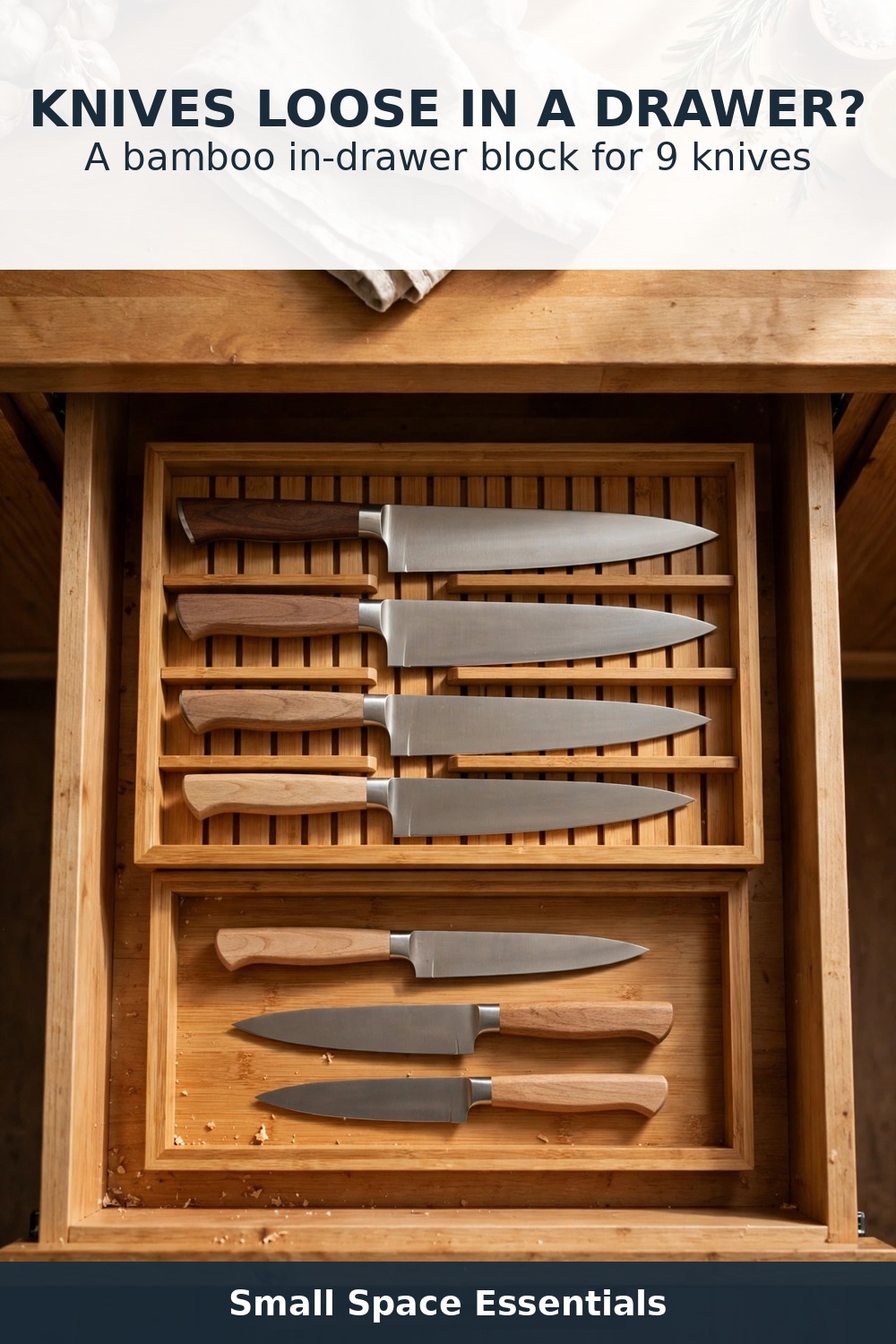
The organiser in our pin — Joseph Joseph's DrawerStore — solves it with geometry instead of space. It's a two-tier bamboo tray that sits inside a standard drawer and holds knives stacked at an angle: larger knives in the lower tier, smaller ones above, handles raised toward you, blades slotted safely below. Nine knives, in the footprint of about four lying flat.
Why the angle matters: in a flat tray, knives nest on top of each other and you lift three to reach one. Angled, each handle presents itself separately. You open the drawer and take the knife — that's the whole interaction. It sounds like a small thing until you multiply it by every meal you cook.
In a small kitchen, storage isn't about having less. It's about everything being reachable in one movement.
Setting it up properly
- Measure the drawer first. Internal height is the constraint — the organiser plus knife handles needs clearance to close. Most standard drawers are fine; shallow cutlery drawers may not be.
- Big knives low, small knives high. Chef's knife, bread knife and cleaver in the bottom tier; paring and utility knives on top. Heavy at the base keeps the tray stable.
- Blades dry before they go in. Bamboo wipes clean and shrugs off daily use, but storing wet blades in any organiser invites rust spots on the edges.
- Keep the odd ones out. Steak knives and the mystery knife nobody uses belong in a different drawer — nine slots are for the nine you actually reach for.
The counter you get back
The real prize isn't the tidy drawer — it's everything downstream. The counter quarter the block used to occupy becomes prep space. The drawer next to it can finally hold the utensils that were sharing with the knives. And because the knives now have an obvious home, they get put back there, which is the entire secret of a kitchen that stays organised: not discipline, but a home so obvious that tidying is the path of least resistance.
If your kitchen has one more drawer doing double duty, the pantry story below applies the same logic to dry goods — five boxes, one shelf, everything visible. Small kitchens don't need more space. They need fewer negotiations per meal.
And a small safety note that matters: a knife you can see, in its own slot, is a knife you never grab blind. Most drawer injuries happen while rummaging — the exact behaviour the loose pile trains into you. The organiser ends the rummage, which makes it that rarest of kitchen purchases: one that is simultaneously tidier, kinder to your blades, and safer than what it replaced.